
In a moving farewell speech before an enormous crowd in Chicago last week, President Obama evoked the American creed of unity and aspiration as the foundation of our democracy. He has always embraced a vision of America as a “melting pot.”
Mr. Obama embodied for many Americans the legacy of the Rev. Dr. Martin Luther King Jr., whom we celebrate on Monday. Our national memory of Dr. King has, for nearly 50 years, reinforced the belief that America, unlike any other nation, could extend opportunity to everyone regardless of his or her identity. In Dr. King’s name, assimilation and aspiration have been the keywords of the post-civil rights era, and diversity and inclusion its currency. And Mr. Obama has symbolized more than anyone in American history the idea that racial representation and the content of one’s character were the perfect antidote to racism.
It’s true that, in fulfilling the duties of the presidency with great dignity, Mr. Obama represents the highest expression of the goal of assimilation. But for African-Americans, he was also the ultimate lesson in how this antidote alone is insufficient to heal the gaping wounds of racial injustice in America. It’s clear that black leadership, in itself, isn’t enough to transform the country. So we must confront the end of an era and the dawn of a new one.
We now live in a post-assimilation America. The 50-year-old rules for racial advancement are obsolete. There is no racial barrier left to break. There is no office in the land to which an African-American can ascend — from mayor to attorney general and the presidency — that will serve as a magical platform for saving black people and our nation’s soul from its racist past. We cannot engineer a more equitable nation simply by dressing up institutions in more shades of brown. Instead, we must confront structural racism and the values of our institutions.
So what does creative dissent look like in a post-assimilation America?
We must recognize that institutions are far more powerful than individuals, no matter how many people of color can be counted in leadership. Structural racism is immune to identity politics. That Eric Holder and Loretta Lynch became attorneys general, for example, was the starting point for the possibility of federal criminal justice reform — not the reform itself.
In addition, history matters. Black people in charge of, or embedded in, institutions that have not atoned for their history of racism can make it easier for those institutions to ignore or dismiss present-day claims of racial bias. That’s because the path to leadership has often meant accepting institutions as they are, not disrupting them. Consider what black Harvard Business School alumni told the journalist Ellis Cose: A key to success is “never talk about race (or gender) if you can avoid it, other than to declare that race (or gender) does not matter.”
As the failure of the black political leadership in Baltimore to protect black lives and the limited ability of black police chiefs to curb brutality in their own departments demonstrate, people of color can inherit or perpetuate structures of inequality. Many institutions of government, finance and higher education were built on the backs of enslaved African-Americans and remain haunted by that history. Diversity and inclusion policies, therefore, should grow out of truth and reconciliation practices as well as strategic hiring plans. Intentional transformation, even reparations, one government agency, one company, one college at a time moves us past the denial and the empty promises and will take us closer to where Dr. King wanted America to go.
Georgetown University’s decision to make reparations for its past is a powerful expression of creative dissent. Last year, after its president met with descendants of the enslaved African-Americans owned by the university he declared, “We cannot do our best work if we refuse to take ownership of such a critical part of our history.” Georgetown will provide preferential admissions to descendants, akin to legacy status for the children of alumni.
Other colleges should take heed. The measure of institutional change will not simply be a new diversity task force or more faculty members of color. We should judge transformation by how our institutions behave on behalf of individuals rather than the other way around.
Some Black Lives Matter activists have already embraced the possibilities of the new era. “We don’t need more elected officials that are just black,” Charlene Carruthers, national director of the Black Youth Project 100 in Chicago, said to a reporter. “We need champions in the city.”
Mr. Obama himself seems ready to move on from the era of assimilation. In his farewell speech, there was no more self-congratulatory praise for a country that gave him a chance to be president. Instead, he acknowledged, for the first time, the very real threat of racism to our democracy and the contingent nature of racial progress.
In a revision to the American creed, he added, equality may be self-evident but it has “never been self-executing.” And he listed specific areas where systemic racism needed to be uprooted, which he hadn’t done in his State of the Union addresses or inaugural speeches: “If we’re going to be serious about race going forward, we need to uphold laws against discrimination — in hiring, and in housing, and in education and in the criminal justice system.” As it turns out, there is no straight line of progress from Seneca Falls to Selma to Stonewall.
In post-assimilation America, people of color must continue to pursue leadership roles as the demographics of the nation inexorably change. But they must also reject their personal achievement as the core measure of progress and instead use history as a tool to measure systemic change. To proceed otherwise is to perpetuate the “fantasy of self-deception” that Dr. King rejected.
The future is no longer about “firsts.” It is instead about the content of the character of the institutions our new leaders will help us rebuild.
 CURATING THE CLASSROOM
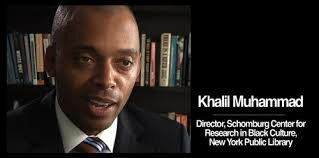
Khalil Gibran Muhammad very quickly asks the reader the following question:
“So what does creative dissent look like in a post-assimilation America?” This idea of creative dissent interests me and is something I feel like I’ve been perusing myself. How can I oppose systematic beliefs or norms in a creative way and how can I do it without being argumentative or feeling overwhelmed by what sometimes feels impossible? Muhammad continues by explaining that “We must recognize that institutions are far more powerful than individuals, no matter how many people of color can be counted in leadership. Structural racism is immune to identity politics.” This is why it is so important to address structural racism, sexism or any type of ism and to be transparent about it. “the path to leadership has often meant accepting institutions as they are, not disrupting them. . . Consider what black Harvard Business School alumni told the journalist Ellis Cose: A key to success is “never talk about race (or gender) if you can avoid it, other than to declare that race (or gender) does not matter.” I’m curious what people think about these quotes and how or if you see this relating to our work or your work in any way. . .
LikeLike